Having resolved my selvedge problem I wove a further two shawls using novelty yarns as the weft. It all worked very nicely and they were a joy to weave.
I used Paton's Sorrento for the weft on a lacy shawl - it's OK [just] but there are too many completing elements with lace and a very nubbly yarn combined. I will use the yarn again but in a different combination - probably just a very open plain weave.
So, now I have to decide what to do next. Looking at my shelves I don't seem to have a shortage of yarns with a good selection that I bought in America a couple of years ago.
The trouble is that I got carried away with the colours and bought lots of little bits. For example I bought 2/18 wool in 8 colours but not more than 2oz of any particular one. I shall have to do few calculations to see what I can come up with. Whatever I weave next there must be movement, bumps and puckering!
Tuesday, October 18, 2011
Sunday, September 11, 2011
Selvedges and Pi
When weaving the lace shawl I noticed that the selvedge threads were considerably tighter than the rest of the warp. I couldn't work out why and assumed I must have done something silly when lacing on. With the shawl off the loom and having been allowed to relax and with a bit of pulling and stretching it seems to be OK.
I retied the warp with particular care to make sure that all of the ends were under equal tension. After about nine inches of weaving the same thing happened again - a tightening of the selvedges. The picture on the left shows how the warp is curving up at the selvedge. I looked at everything again, inspected my draft and then felt very silly when I realised the cause.
In balancing the disposition of the warp on the sectional warp beam warp I had beamed the warp so that I had the selvedges [four threads on each side] in their own section. These threads had more space so the warp did not wind up to the same diameter as all the other sections. This can be seen in the picture on the right.
As we all know, C/D = Pi, so the two selvedge sections that I measured as having a diameter of 5.9 cm has a circumference of 18.535 cm whereas the other sections with a diameter of 6.4 cm has a circumference of 20.106. What this means that for every 8 inches of warp released from the back beam only about 7.3 of the selvedge threads were being released. It soon mounts up!
It is all corrected now, the selvedge threads are off the warp beam and dangling at the back appropriately weighted. I now know that I should not have sections with less than the standard epi in them. This means a better balancing of the pattern repeat with the epi. If I need extra threads they must either be beamed separately [or dangled down the back] or I could fill the whole section anyway and just use the threads that I need.
I retied the warp with particular care to make sure that all of the ends were under equal tension. After about nine inches of weaving the same thing happened again - a tightening of the selvedges. The picture on the left shows how the warp is curving up at the selvedge. I looked at everything again, inspected my draft and then felt very silly when I realised the cause.
In balancing the disposition of the warp on the sectional warp beam warp I had beamed the warp so that I had the selvedges [four threads on each side] in their own section. These threads had more space so the warp did not wind up to the same diameter as all the other sections. This can be seen in the picture on the right.
As we all know, C/D = Pi, so the two selvedge sections that I measured as having a diameter of 5.9 cm has a circumference of 18.535 cm whereas the other sections with a diameter of 6.4 cm has a circumference of 20.106. What this means that for every 8 inches of warp released from the back beam only about 7.3 of the selvedge threads were being released. It soon mounts up!
It is all corrected now, the selvedge threads are off the warp beam and dangling at the back appropriately weighted. I now know that I should not have sections with less than the standard epi in them. This means a better balancing of the pattern repeat with the epi. If I need extra threads they must either be beamed separately [or dangled down the back] or I could fill the whole section anyway and just use the threads that I need.
Tuesday, September 6, 2011
Lace and Overshot
In chapter 12 of "... 8 Shaft Patterns by Carol Strickler..." is #488 which is described as being "Diamond in lace and overshot from Manual of Swedish Handweaving..." It caught my eye because the threading is very similar to that in my Ultimate threading that I have been getting so excited about in previous posts. I now know that what I have "discovered" is just an extension of multishaft overshot but I hadn't realised that so much could be done with it.[http://gangewifre.blogspot.com/2011/07/ultimate-threading.html].
The draft is shown below slightly modified [the lilac one] and the two in black and white are some extensions of the idea to 20 shafts.

Having just finished weaving the Lace Shawl I wove a bit of a sample of this lace/overshot draft. Lace seems to work best on slightly less than the plain weave sett and overshot [IMHO] works better on something slightly tighter so it will be interesting to see how this turns out when I get it washed. I suspect that it will be a little bit too sleazy - no matter as the plan for this warp is that it gets progressively close in sett so I will weave a progression of samplers.
The draft is shown below slightly modified [the lilac one] and the two in black and white are some extensions of the idea to 20 shafts.
Sunday, September 4, 2011
Lace Shawl
I have threaded the loom [AVL WDL] with my Ultimate Threading and the first cab of the rank is a lace shawl. The yarn is Bendigo 2 ply set at 13.5 epi and all is going well. Shaft 24 has finally given up the ghost [the wire from the shaft to the dobby is kinked and will not engage consistently with the electromagnet) but it was no matter as I was just using the shaft for the selvedge so I was able to switch to another one.
I am using live weight tension on the warp beam at the back of the loom. I have kept the AVL brake cord, I have just detached it from the loom frame and attached 10lbs as the main weight and x2 1lb sinker as the counter weight.

Because I have had problems with the ratchet and pawl on the front sandpaper beam I have put on a similar live weight tension system at the front of the loom which pulls in the opposite direction. I adjust the weights so that the warp can be advanced with the lightest of touches on the ratchet leaver. In practise this means that I advance the warp much more often than I used to.
Before stumbling on this system I advanced the warp whenever I moved the temple, about every 2". Now I move it forward about every half inch - there are no ratchets engaged or disengaged in the process so everything is very smooth. Too much weight and the warp will advance just from the pressure of the beater; I tried this as a means of advancing the warp but I could not get a consistent beat. The front beam has 2 lbs pulling the warp forward - I suppose the difference needed is due to the friction of the yarn on the back beam heddles and reed.
The diagram shows the principal
I am using live weight tension on the warp beam at the back of the loom. I have kept the AVL brake cord, I have just detached it from the loom frame and attached 10lbs as the main weight and x2 1lb sinker as the counter weight.
Because I have had problems with the ratchet and pawl on the front sandpaper beam I have put on a similar live weight tension system at the front of the loom which pulls in the opposite direction. I adjust the weights so that the warp can be advanced with the lightest of touches on the ratchet leaver. In practise this means that I advance the warp much more often than I used to.
Before stumbling on this system I advanced the warp whenever I moved the temple, about every 2". Now I move it forward about every half inch - there are no ratchets engaged or disengaged in the process so everything is very smooth. Too much weight and the warp will advance just from the pressure of the beater; I tried this as a means of advancing the warp but I could not get a consistent beat. The front beam has 2 lbs pulling the warp forward - I suppose the difference needed is due to the friction of the yarn on the back beam heddles and reed.
The diagram shows the principal
Monday, July 25, 2011
Deflected Double Weave
I was looking at some 18/2 Merino sitting on my shelf and thought that it might be a good idea to do some Deflected Doubleweave. So I re-read the article "Deflected Doubleweave: beyond the basics" by Madelyn van der Hoogt. I tried various profiles as suggested and then played with my weaving software (Pixeloom) to see if I could automate the creation of the full threading. I ended up with this method;

1. Draw a twill threading with alternate colors in the warp. This example is very simple just to illustrate the method.
2. Expand the threading by 2.
3 Use Block Substitution selecting"overshot".
4 Change number of treadles to 8.
4 Change the tie up to a deflected double weave tie up. I have started keeping all my tie-ups, threadings, treadlings and colour schemes in a Library folder and then using the Import function to bring them into whichever draft I am working on.
5. Use "Tromp as Writ" function to redraw the treadling
6. Use "Use warp colours" function to make weft colours the same as the warp
I did this exercise starting with a various 10 shaft twills so I ended up with several 20 shaft deflected double weave drafts. I came across a draft for 16 shaft deflected double weave in the Files section of WeaveTech (DeflectedDoubleWeave.WIF posted by R S Blau) which helped me understand the tie up variations that are possible. It was this draft that lead me to the "Ultimate" threading that I have referred to in previous blogs


3.

1. Draw a twill threading with alternate colors in the warp. This example is very simple just to illustrate the method.
2. Expand the threading by 2.
3 Use Block Substitution selecting"overshot".
4 Change number of treadles to 8.
4 Change the tie up to a deflected double weave tie up. I have started keeping all my tie-ups, threadings, treadlings and colour schemes in a Library folder and then using the Import function to bring them into whichever draft I am working on.5. Use "Tromp as Writ" function to redraw the treadling
6. Use "Use warp colours" function to make weft colours the same as the warpI did this exercise starting with a various 10 shaft twills so I ended up with several 20 shaft deflected double weave drafts. I came across a draft for 16 shaft deflected double weave in the Files section of WeaveTech (DeflectedDoubleWeave.WIF posted by R S Blau) which helped me understand the tie up variations that are possible. It was this draft that lead me to the "Ultimate" threading that I have referred to in previous blogs


3.
Sunday, July 24, 2011
Ultimate Threading 2
In addition to my previous post the threading also supports Monks Belt and Shadow Weave
Saturday, July 23, 2011
Ultimate Threading
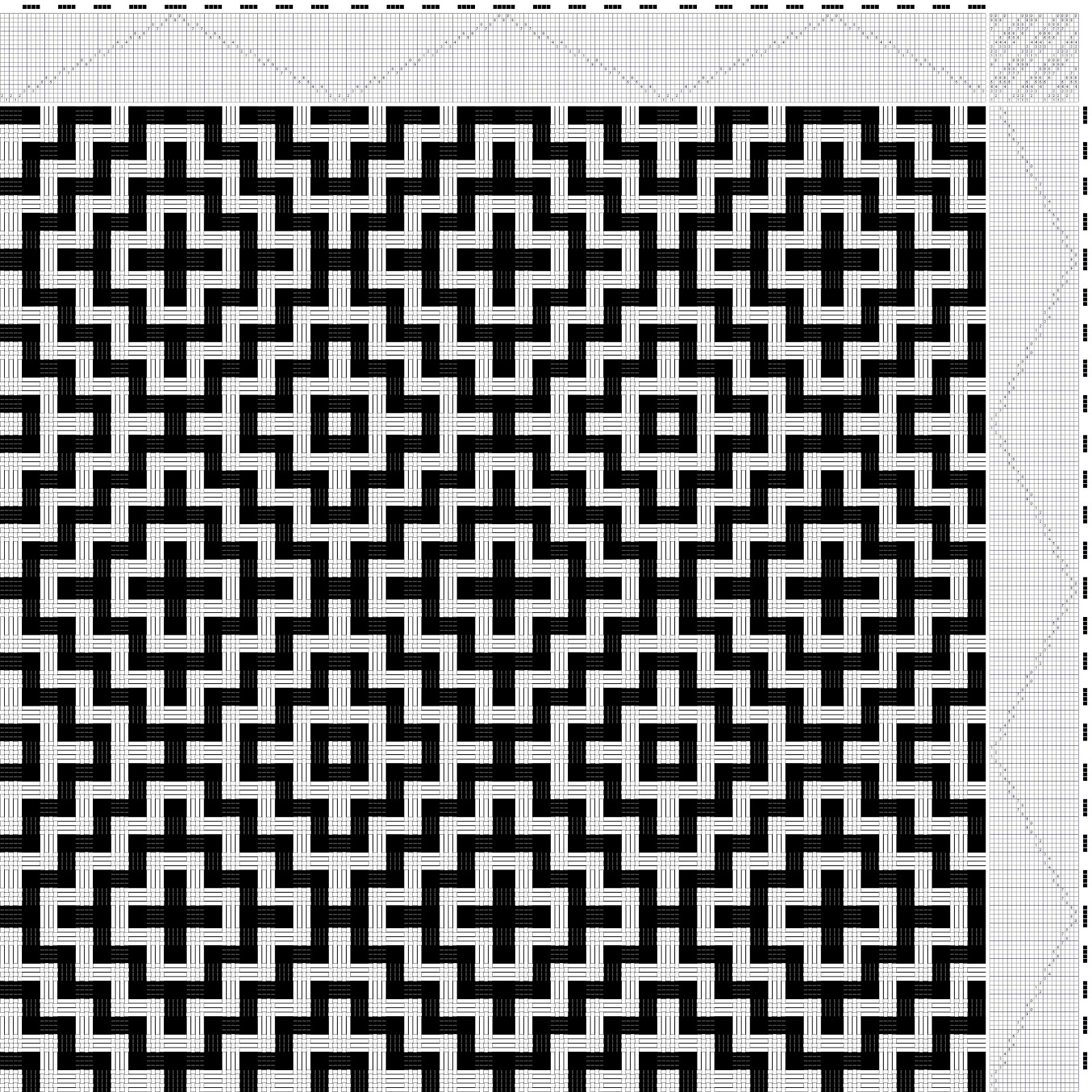
As always it will have been done before, but I have worked out that the threading in pictured below will enable me to weave loads of things without having to re thread for some considerable time
It is an overshot threading with 10 independent blocks on 20 shafts with 4 shafts reserved for the selvedge. The pictures below show what I believe I can weave on this threading;
I am sure that there is more than this but what I have here will keep me busy for months.
It is an overshot threading with 10 independent blocks on 20 shafts with 4 shafts reserved for the selvedge. The pictures below show what I believe I can weave on this threading;
![]() |
| Lace |
![]() |
| Twill - ADI |
![]() |
| Twill -advancing point |
| Twill - curve |
![]() |
| Overshot |
![]() |
| Deflected Doubleweave |
Friday, July 8, 2011
4 Colour Double Weave - first attempt
This blog has been left un updated for a long time – not good.
The two Brighton Honeycomb scarves that I wove on the Glimakra are now off the loom and in constant use. The use of a double weft thread for one of them was very effective. I have put on an alpaca warp that is sitting on the back beam waiting to be threaded. This won’t happen until I have installed the Toika EW24W Control Unit that is on order for an August delivery. I combined the order with a friend who wanted a controller plus a loom from Toika in an attempt to reduce the freight costs. It is a long way from Finland to Australia.
The warp from hell ( see post xxxx) has been woven as 4CDW. It was tentatively going to be a shawl but the cloth is too heavy and the pattern is too variable for it be anything but cushion covers or bags of various sorts. I was plagued with a sticky warp to start off with but once I got the weaving going I couldn’t stop. I will post some photos when I get home tonight.
Monday, April 18, 2011
Low Warp Tapestry Loom
In a previous post I said that I found it much easier to weave tapestry on a horizontal table loom rather than an upright tapestry frame. I had read previously about the two styles of French tapestry high warp (haute lisse, aka Gobelin) and low warp (basse lisse, aka Aubusson), knew what a Gobelin loom looked like and I had seen all the upright tapestry looms that are available on the market. What I had not come across was any information about low warp tapestry looms.
Searching the internet on "low warp" didn't give me much, but once I switched to using French weaving terms (basse lisse, metier a tisser, tapisserie and aubuson used in various combinations) it started getting interesting. It took a while to get used to looking at French sites but what with recalling my schoolboy French and using Google Chrome as my search engine with its translation functions I soon able to get the hand of what I was looking at . I needed to exercise care with the automatic translations as some of them, particularly of weaving terms, came out a bit wide of the mark. For example, fils de chaîne (warp threads) is translated Google as "son of string".
To start with, an explanation of the difference between "Le metier de basse lisse" and "le metier de haute lisse" is here; http://cmthibert.free.fr/cmpages/metiers.html.
I must stress that my research has been on the use of low warp looms for tapestry. The term “basse liise” when applied to looms in French also covers conventional cloth weaving handlooms.
The loom – metier a tisser de basse lisse
The montage of photos below gives a pretty good idea of what the looms look like:-
and here is a larger picture;
The construction is quite straight forward. The main differences between these looms and conventional horizontal looms are;
- No beater
- The warp runs directly from a beam at the back of the loom to a beam at the front of the loom.
- The back beam is mounted in an adjustable dolly or carriage that allows additional control of the tension – over and above that put on by rotating the beams.
- The back beam is higher than the front beam so that the warp slopes slightly upwards from front to back.
- Warp threads are held in place on the front and back beams by a “verdillon” (I can’t find a translation). This is a metal rod that is held in place by hooks set into a groove that runs the length of the beam.
- There are two sheds which are controlled by harnesses positioned below the warp. The connection between the warp and the two pedals is shown in the series of photographs on this page here - http://www.vive-la-creuse.com/ciao93/index.php?post/2008/02/26/La-Tapisserie-sur-Basse-Lisse-4-Montage-de-la-Chaine-fin. It took me a while to work out how this all fits together
- There is a plank just behind the front beam that extends across the width of the loom.
.
Sunday, April 17, 2011
Getting ready to tie on
The two Brighton Honeycomb scarves are finished and safely wrapped round the cloth beam. I have but lease sticks in behind the heddles and cut of the warp where it is dangling ready to be tied onto the new warp. The new warp is beamed and ready to be tied onto the old warp. This is going to be fun!

For this scarf I m going to try Breaks & Recesses (Strickler #47). I will be using chocolate alpaca for both the warp and the weft.
Sunday, April 10, 2011
Two yarns in the weft
Having finished the first Brighton Honeycomb scarf and for the second scarf I have been using a weft of two strands of 15/1 merino and so far it looks quite good. I have no idea how it will behave when I washed but I wove a 12" sample that I shall experiment with first.

I tried using a shuttle with two bobbins but got into an awful pickle with the selvedges so I fabricated a doubling stand from a milk crate and wove successfully with the two strands wound onto one bobbin.
Tuesday, April 5, 2011
Weaving on a Countermarch Loom
Last week I started weaving and it is all good.
My first threading is straight 8 with a Brighton Honeycomb tie up. I have woven this before so I know what to expect and can focus on the touch sound and feel of the loom. The warp is two colours of Bendigo 2 ply (Pampas and Ginger) set at 18epi and for the weft I am using some nice 2/12nm chocolate (70% alpaca / 30% bluefaced leicester) yarn that I bought in the UK a couple of years ago.


I did a bit of sampling first to get a colour combination that I liked and also to get used to the overhead beater. It was all over the shop to start of with but settled down after a while. I still have to squint down to check that I am getting the correct treadle but I am not having to adjust as much as I did when I started.
The amount of effort that I have to expend is minimal so I find that I am weaving for much longer at a stretch. The size of the loom suits me and I like the fact that I can see exactly what is going on. I get up every now and then, take a stroll round the loom, give it a pat and then it is back to the pilots chair and the loom and I sail serenely on. A bit fanciful I know but the creak of the beam and the sounds of the treadles and the two capstan wheels on the side all bring images of large sailing ships to mind.
My first threading is straight 8 with a Brighton Honeycomb tie up. I have woven this before so I know what to expect and can focus on the touch sound and feel of the loom. The warp is two colours of Bendigo 2 ply (Pampas and Ginger) set at 18epi and for the weft I am using some nice 2/12nm chocolate (70% alpaca / 30% bluefaced leicester) yarn that I bought in the UK a couple of years ago.
I did a bit of sampling first to get a colour combination that I liked and also to get used to the overhead beater. It was all over the shop to start of with but settled down after a while. I still have to squint down to check that I am getting the correct treadle but I am not having to adjust as much as I did when I started.
The amount of effort that I have to expend is minimal so I find that I am weaving for much longer at a stretch. The size of the loom suits me and I like the fact that I can see exactly what is going on. I get up every now and then, take a stroll round the loom, give it a pat and then it is back to the pilots chair and the loom and I sail serenely on. A bit fanciful I know but the creak of the beam and the sounds of the treadles and the two capstan wheels on the side all bring images of large sailing ships to mind.
Sunday, March 20, 2011
Countermarch
In January I bought a Glimakra 47" standard. I have been working my way through putting it together, tying it up, untying it up, buying the definitive book (Joanne Hall) and then tying it all up again correctly.
The warp that I put on is two colours of Bendigo 2 ply (Pampas and Ginger) set at 18epi.
The knee beam makes a handy place to rest the reed when sleying

.
To my surprise I was able to get right into the loom (it was a bit of a squeeze) and after a while I was positively hopping in and out. It is better than yoga!
The warp that I put on is two colours of Bendigo 2 ply (Pampas and Ginger) set at 18epi.
The knee beam makes a handy place to rest the reed when sleying
.
To my surprise I was able to get right into the loom (it was a bit of a squeeze) and after a while I was positively hopping in and out. It is better than yoga!
Thursday, January 13, 2011
Dodgy drafting
My intention was to weave a stitched double weave shawl. The draft was based upon the work I did with stitched double weave to produce a wall hanging. I decided to take one motif (a diamond) and use it to stitch together two loose plain weave layers. My yarn was bendigo 2 ply that normally sets at 14 epi for plain weave so I decided on 12 epi for each layer making an overall sett 0f 24 epi. I carefully sampled this and was happy with the result.
Where I went wrong was when I amended the draft to 22shafts, with two left over for selvedges (which you don't need for plain weave!). For some reason that I can't now fathom I decided that a point threading was the way to go. I amended the draft and produced a new .wif and it all looked good. At the time I was very pleased with myself as i can see from what I wrote: - Bi colour warp on pointed threading
I put on the warp the loom, battled through the initial stickiness and with help worked out how to a use the sandpaper beam effectivly and started weaving. Disaster, unexpected floats appeared. Investigation showed that my design was flawed - you can't weave two layers of plain weave on a pointed draft. Once I realised the problem it seemed obvious. One layer of double weave is woven on the odd shafts, the other on the even shafts. With a pointed draft you are going to get two adjacent threads in a layer on the same shaft whenever the draft turns.
As I had spent a fair bit of time getting the warp on I was keen to use it for something so I decided to try a turned taquete draft. Again it looked OK on paper (or strictly speaking "on computer") but having woven about six inches, using 28/2 alpaca-silk as the weft, I don't think that is going to work. It looks insipid because the warp colours were selected for the double weave shawl and do not suit the new draft and as everyone says, you should use something shiny.
So, I am going to bite the bullet and re thread to a straight 24. Several lessons learnt but this double weave shawl is going to be good when it is done!
Where I went wrong was when I amended the draft to 22shafts, with two left over for selvedges (which you don't need for plain weave!). For some reason that I can't now fathom I decided that a point threading was the way to go. I amended the draft and produced a new .wif and it all looked good. At the time I was very pleased with myself as i can see from what I wrote: - Bi colour warp on pointed threading
I put on the warp the loom, battled through the initial stickiness and with help worked out how to a use the sandpaper beam effectivly and started weaving. Disaster, unexpected floats appeared. Investigation showed that my design was flawed - you can't weave two layers of plain weave on a pointed draft. Once I realised the problem it seemed obvious. One layer of double weave is woven on the odd shafts, the other on the even shafts. With a pointed draft you are going to get two adjacent threads in a layer on the same shaft whenever the draft turns.
As I had spent a fair bit of time getting the warp on I was keen to use it for something so I decided to try a turned taquete draft. Again it looked OK on paper (or strictly speaking "on computer") but having woven about six inches, using 28/2 alpaca-silk as the weft, I don't think that is going to work. It looks insipid because the warp colours were selected for the double weave shawl and do not suit the new draft and as everyone says, you should use something shiny.
So, I am going to bite the bullet and re thread to a straight 24. Several lessons learnt but this double weave shawl is going to be good when it is done!
Wednesday, January 12, 2011
Overshot Sampler
The overshot sampler was finished before Christmas.
I tried as many yarns as I could for the pattern weft, some were good and some were shocking but I deem the project to be a success in that I now have definite ideas about the yarns I shall be using for my three planned overshot projects!
Upholstery - 16/2 cotton for warp and tabby, 11/2 wool (bendigo 2 ply) for patern weft.
Wall hanging - 16/2 coton for warp and tabby, DMC perle cotton #5 for pattern weft. I might well do the wall hanging in Monks Belt.
Scarf & Shawl - 28/2 alpacca-silk for warp, 28/2 merino for tabby ( or maybe 28/2 silk as well) and 18/2 Zephyr wool-silk for pattern weft
The actual projects will have to wait as I have just started a turned taquete shawl - more on this later.
I tried as many yarns as I could for the pattern weft, some were good and some were shocking but I deem the project to be a success in that I now have definite ideas about the yarns I shall be using for my three planned overshot projects!
Upholstery - 16/2 cotton for warp and tabby, 11/2 wool (bendigo 2 ply) for patern weft.
Scarf & Shawl - 28/2 alpacca-silk for warp, 28/2 merino for tabby ( or maybe 28/2 silk as well) and 18/2 Zephyr wool-silk for pattern weft
The actual projects will have to wait as I have just started a turned taquete shawl - more on this later.
Wednesday, December 15, 2010
Overshot sampling
I have had some overshot projects lurking in the back of my mind for some time now. It is over three years ago that we all first studied overshot in our weaving classes and I have decided to revisit this technique over the Christmas holidays.
I put a 3 yard wrap of 16/2 cotton set at 24epi onto my table loom and I have been weaving a series of little 6" to 8" samples varying the wefts and the beat. So far for tabby I have used 16/2 cotton, 20/2 perle cotton, 28/2 silk/alpaca, 28/2 merino and 18/2 merino. For pattern weft I have tried perle cotton, 11/2 wool, 18/2 wool/silk, appletons crewel wool and 22/2 merino. I have a few more yarns to try and I want to see what some treadling variations look like.
This should be finished in a few days then I will cut them off, hem and wash them to see how they all turn out. I might tie on a short warp of 28/2 silk/alpaca to see how it goes. The objective of this exercise is to come up suitable yarn, treadling and beat combinations for a scarf, a wall hanging and some yardage for a skirt.
It is so nice to be doing straight forward weaving again!
I put a 3 yard wrap of 16/2 cotton set at 24epi onto my table loom and I have been weaving a series of little 6" to 8" samples varying the wefts and the beat. So far for tabby I have used 16/2 cotton, 20/2 perle cotton, 28/2 silk/alpaca, 28/2 merino and 18/2 merino. For pattern weft I have tried perle cotton, 11/2 wool, 18/2 wool/silk, appletons crewel wool and 22/2 merino. I have a few more yarns to try and I want to see what some treadling variations look like.
This should be finished in a few days then I will cut them off, hem and wash them to see how they all turn out. I might tie on a short warp of 28/2 silk/alpaca to see how it goes. The objective of this exercise is to come up suitable yarn, treadling and beat combinations for a scarf, a wall hanging and some yardage for a skirt.
It is so nice to be doing straight forward weaving again!
Wednesday, November 24, 2010
Tapestry
At long last I have finished this tapestry. The most difficult part was deciding how I as going to treat the dangling ends. I tried several treatments but ended up with this one which is made of painted fishing weights. I shall call this work " Composition in cotton, wool, lead, acrylic and bamboo"! The bamboo bit is the hanging stick.
The tapestry workshop that I referred to in an earlier post has been and gone. The topic for our work was "The Owl and the Pussycat". This photos below shows how far I have got.
I am finding the diagonal lines very tricky! I hope to find some time over the Christmas holidays to get it finished but in the meantime I have a threaded loom which is calling out to me to weave some stitched double eave and turned taquete.
Subscribe to:
Comments (Atom)