Pages

Tuesday, August 25, 2015

Advancing the temple


I feel very exposed when weaving a twill. Even the slightest inconsistency in the beat seems to show up as a warp coloured streak and even though I know that when the cloth is off the loom and relaxed and then after it has been finished most of the blemishes will be gone it still bothers me.

I have come up with a few things to help me. The first has been to stop listening to the radio when I weave. I listen to Classic FM and I suspect that the change of tempo of the music impacts on how I weave. The music and the talk from the presenters lead me away from the weaving.

Following on from stoping the distraction of the music I am trying to focus just on the weaving,to watch the weft being beaten in, to feel the tension in my shuttle and just to be with what I am doing. This is all a bit metaphysical but it seems to be working. On a more down to earth note, I am advancing my temple in a consistent fashion.We all know it should be moved after about one inch of weaving, but hey, when you are in the zone and there is a nice bit of Bach on the radio, three inches with no temple movement can creep up on you just like that.

Tricot DraftMy weaving software (WeavePoint) plays a sound whenever the weft colour changes. On the draft I have changed the colour every 18 picks (the PPI of my current project) so when the computer goes bing I know it is time to advance the temple. On my loom I can move the beater so I only have to advance the warp about every three inches; so I use three colours so that I know exactly where I am.

IMG_2723 Beater Rests

The combination of this and the vibes thing seems to be helping but time will tell.

In addition to all this I managed to get some weaving done today.


IMG_2735

Twill Scarf update

IMG_2726 Scarf End


The herringbone scarf is finished (I fear that I might have been a bit too subtle in my colour choices) and I am now sampling for the next scarf. The photo below is of a variant of a Tricot weave and I fancy a bit of red. I shall try beating a little harder to make it slightly weft faced.

IMG_2733

Sunday, August 23, 2015

Twill Scarves progress

The first scarf is finished (at the bottom of the  left hand photo) and I have been trying a bit of herringbone. The last sample is with a moss green weft and it looks very effective in a nice understated way. This shall  be the next scarf with some contrasting colours at the ends, looking a bit like the second photo – I hope.

IMG_2718 Samples Scarf

Saturday, August 22, 2015

Twill Scarves

 IMG_2706 Warp

I have put on a 12 yard warp of Bendigo 2 Ply -  Raffia (Bendigo Woollen Mills only do their 2 ply in 500 gram cones now) sett at 18 EPI  for some twills scarves. I have threaded a straight draw on 16 shafts with a further 4 shafts for the selvedge. You can do a lot on a straight 16!

I have woven a sample trying out some plaited twills and for the first scarf I shall use the undulating plaited twill from A Handbook of Weaves- Oelsner using the shade Denim Blue for the weft.

IMG_2717 Sample

 Capture

Friday, August 21, 2015

Loom lights

I have never been completely happy with the lighting of my work as I am weaving. I have no problems during the day but when I have to rely on artificial light my arrangements have been less than ideal. I have used lights clamped to the uprights of the beater (are they called swords?) and some LEDs just above the reed. Quite good but the fell has always had a bit of shadow about it.

IMG_2695IMG_2709

I bought a light designed to go under a kitchen cabinet and I have rigged up a sort of gantry that is attached to the front uprights of the loom. The result is brilliant (literally) and I have been weaving away quite happily this evening with not a shadow in sight. There goes my last excuse for an uneven beat.

The photo shows the left hand side of tIMG_2710he arrangement and the LED lights on the beater can be seen. I shall tidy up the cable arrangement and fit a small pelmet along the top. At the moment the uprights are held in position by cable ties and clamps. When I find time I shall make some wooden clamps do that things look a bit neater. Clamps and cable ties are great for this sort of thing – one can experiment and move things around without having to harm the loom.

Friday, August 7, 2015

Huck Lace Shawl

I have just finished this shawl. It is based on the draft from Handwoven 2009 May June – “Light & Lacy Huck Scarf. I used a 4ply knitting yarn (Morris Estate 4 Ply) set at 10 EPI and widened the draft so that the shawl came out at 22” wide. It is a 4 shaft draft which I wove on a straight 10S threading. All good but I have made it a bit too long and it is very chunky.


Huck Shawl

Tuesday, August 4, 2015

Tapestry

I am trying a little tapestry. Not sure what will come of it but so far so good. I have just reached the tree trunks.

Confused smile


IMG_2680 (2) Tapestry

Friday, July 31, 2015

Differential Shrinkage Scarf


 The scarf that I started back in May has been off the loom for some time and has been sitting on the spare room bed "relaxing". I got round to twizzling and washing one of them ( I wove two) last week and all went well. Quite a lot of shrinkage- it went down from 96" off the loom to 60" after the treatment. Very exciting!

Tuesday, May 26, 2015

Tarp Clamp Temple

A couple of posts ago I mentioned that I was using "crocodile clips" and weights to serve as a temple. I think that strictly speaking the device that I am using is a "tarp clamp".

I have used then for one scarf and they are fine but I found that I was getting a bit of distortion of the cloth when the clamps were advanced (every inch) to keep up with the fell. This happens because of the increasing angle between the clamps and the pivot points that  leads the cords to the weights. The mechanics of the whole thing are shown here and the picture below shows angle of the cord and the cloth distortion.


I have a solution which I think will resolve most of the problems. I have taken a couple of blocks of wood and attached screw eyes and four "legs" made from old Venetian blind slats (ideal for packing the warp when beaming).

The blocks sit on the side rails and are held in position by their legs. The cord from the clamp goes through the screw eye and the down to the weight.

The blocks can be moved back and forth on the side rail which means that pivot point, the screw eye, can be kept almost level with the fell.

It is all a little bit Heath Robinson at this stage but I'll weave off the current scarf and see how I go - I am sure that other refinements will occur to me!


 I have just noticed that comments on this blog are not working correctly. An initial comment can be made but the subsequent thread doesn't seem to be working. If you have posted a comment and not received a response from me please accept my apologies; I will resolve the problem as soon as I can./

Tarp Clamps can be bought in Australia from Bunnings and they are also stocked by several camping shops.


Wednesday, May 13, 2015

Scarf Colours

This picture of the yarns that I am using for the scarf gives a better idea of the colours - something along the lines of a old copper pot encrusted with verdigris!


Tuesday, May 12, 2015

Differential Shrinkage Scarf

I put on the warp for this scarf a couple of weeks ago but I have been hit by the lurgy (flu/cold) so until today I had done nothing. Today I wove for three hours and the scarf is about half done.

The design is taken directly from Evening Sunset Scarf by Stefanie Meisel in Handwoven Sept/Oct 2004. I have changed one of the yarns (18/2 Merino replaced with 20/2) which should make little difference. This scarf will differ from the last one I did in that there are ruffles on the outer edge of the scarf.

The photo below doesn't do justice to the colours. The merino is a vibrant turquoise green and the non-shrinking tencel is two shades of copper. I will pay more attention to my lighting when I next take a picture.


This is the first time that I have used a "crocodile clip" temple and it is working very nicely. I have used a couple of sawn down  wood working clamps to to hold the cord between the clips and the weights. The trick is to make sure that the arrangement clears the beater and doesn't get in the way when throwing the shuttle 

Tuesday, April 21, 2015

Ruffled Scarf in Collapse Weave

I started this scarf in the middle of last year. It has been languishing in a box un-twizzled and unwashed. That has been rectified and here it is.


The yarns are 18/2 Merino (the shrinker) and 8/2 Tencel (the non-shrinker). I have followed almost to the letter (apart from the colours) the instructions in the article by Stefanie Meisel in Handwoven 2004 Sept/Oct.

Here are some of the details;


Monday, April 13, 2015

Weavers Elbow

I think that I may have been a little too gung-ho in my experiments with end feed shuttles (see last post). For the past month I have been afflicted with very painful tennis elbow (or maybe golfers elbow) which has not been caused by tennis (wrong arm)  and which has been quite incapacitating. The only thing that I can think of that could have caused it is weaving with a half kilo shuttle! Idiot!

Sunday, March 1, 2015

End Feed Shuttles

Weaving the Waffle Weave Shawl (it is off the loom and resting in preparation for being fringed and washed) necessitated fairly frequent colour changes so I took the opportunity to try some different shuttles.

For the beige areas of the shawl I used a Crossley hand weaving shuttle. I wish that I could get another. It fits nicely in the hand and just glides across the shed straight and true with the smallest of flicks. It has a Honex tension adjustment mechanism; I think that I was told that it is made of persimmon wood.


I have two AVL 11" shuttles that I used for the coloured stripes. I bought these some time ago and have used them extensively over the years as they seem to be just the right size for scarves. I find them a little on the light side after using the Crossley and they are not very kind to any errant warp ends. As the inset on the photo below shows the tips are square rather than tapered and the Honex mechanism protrudes above the body of the shuttle. When using them I cover this protrusion with masking tape but the blunt end can still cause problems if I slightly mis-throw the shuttle or have a lazy warp end. I shan't be using these again until I have had a go at them with an angle grinder, rasps and sandpaper.


Over the years I have built up a small collection of metal tipped end feed shuttles that are for use with a fly shuttle. Because they have sharp metal tips they are not, in theory, that much good for being  hand thrown but I decided to try anyway with some of the blunter ones.

The first one tried quite successfully was another Crossley which I have shown below. The tension of the yarn as it leaves the shuttle is controlled by fur like fabric that brushes against the side of the filled pirn and by some felt in hole though which the yarn leaves the shuttle. I presume that each shuttle was designed for a specific small range of yarn thicknesses as there is no mechanism for adjusting the tension. It worked fine with the yarn that I was using (11.5/2 wool). I don't have any pirns that fit but one from my AVL shuttle worked nicely enough.


The second metal tipped shuttle that I tried was a bit of a beast but it was surprisingly easy to use. It has an adjustable Honex type tension adjuster. I thought that it might be a bit hard on the wrists but I wove with it for over an hour with no adverse effects.


I shall blunt the tips of these two shuttles a little and then they can move from my shuttle collection box to my working shuttle box.

Tuesday, February 17, 2015

Waffle Weave Shawl

After a little break from weaving I have started work on a Waffle Weave Shawl. The warp is a straight 24 threading left over from the mock leno shawl that I wove just before Christmas.

I am weaving bands of colour which will use up some of my old stocks of Bendigo 2 ply. The draft uses a 4 shaft point threading which I have extended to 24 shafts. It is all coming along nicely and should be finished by the end of the week.


Thursday, January 1, 2015

Mock Leno Shawl

I completed this shawl just before Christmas as a gift.


To be honest I am not too happy with it - I wanted to weave an evening shawl but what I have produced would be better suited to a winter's evening in front of the television. Must try harder!


Thursday, October 23, 2014

Huck Baby Blanket

I have just finished weaving a baby blanket in huck lace. My starting point was the article by Linda Ligon in the 1999 May June edition of Handwoven. As I was planning to put on a straight 24 threading I worked out a similar pattern (originally from Carol Strickler) in the lift-plan of my weaving software (Pixeloom).  Shafts 1 and 12 provided the plain weave for the selvedges.

There were 666 ends in the draft so it seemed to take a long time to get the loom ready for weaving.

I got into a bit of a muddle on how to get the taped bouts from sectional warping into position for threading but with help from members of Weavetech I got there in the end.

The blanket is fairly straightforward and has been sent off to the baby. This exercise was interesting for me because it represented several firsts for me.

  • Weaving in cotton. I have woven samplers in 4 ply cotton but this was the first time that I had used cotton (8/2) for a complete piece. I had to beat harder than I usually do to maintain 18ppi. I don't know if this was because of the yarn, the draft or the width.
  • Weaving with width. The width of the warp on the loom was 37" which is over a foot wider than anything I have done before. I played around with various shuttles and practiced my throw; I got on best with a 38 cm shuttle with rollers. Once I got the rhythm going there were no problems
  • Weaving standing up. I have raised my loom on bricks by 8" and I wove standing up. No shoulder pains and it was much easier to move around the loom to see what is going on and advance the warp. No more hopping on and off the bench and they do say that too much sitting is bad for you.
I think that I am going to have to find some instructions on fashion photography- I frequently feel that my pictures don't do justice to the work.

The picture below is from my weaving notes. The calculations on shrinkage and draw in were pretty accurate which gives me a good reference point for the future. There is enough warp left on the loom to enable me to tie on the next warp which will save time on the threading. The warp is set at 18 epi which is just right for twill in Bendigo 2 ply or plain weave/lace in cottolin. Mmm... 

Weaving Notes


Monday, September 15, 2014

Differential Shrinkage Scarf

I forgot to take a photo of the finished product but here it is (looking more like a scarf) being worn by Kymberlie who is at a football match with her chap, Wayde.


Sunday, August 24, 2014

Delayed project

After I finished my last differential shrinkage shawl I wound another warp onto the back beam and was ready to start the tie on in April. Other things intervened and I did not return to the project until earlier this month. The shawl is now off the loom and all that I have to do is full it and it will be done.


For this red shawl I have used the same yarns and draft as the blue/turquoise one. The birthday of the intended recipient is long gone and she is expecting in about 8 weeks which means that I need to get a move on with a baby blanket. I have toyed with doing an overshot coverlet but I haven't left myself enough time so I am planning something in huck in 8/2  cotton.

Monday, July 14, 2014

Saori Weaving at Sturt

I spent a very enjoyable week at the Sturt Winter School in a workshop run by Kaz Madigan on Saori Weaving. I have to confess that I had a bit of an internal struggle coming to terms with some of the concepts behind this style of weaving but I think that I got there in the end. Kaz describes it all here much better than I could.

Here are some pictures of my output; there are a lot of very interesting things to be done in a bit of plain weave and when I have finished all my other current projects I shall give some of them a try.


Some of the ones that I tried -

  • Push the weft to make space for weaving lozenges
  • Wind a bobbin with two twisted yarns and then reverse the direction of the twist. When this energised yarn is used in the weft it gives an undulating twill effect
  • Creating uneven tension on the warp
The specialised Saori looms are lovely to use and have several very interesting design features.


Monday, February 24, 2014

Differential Shrinkage Shawl is finished

The shawl is finished and I shall put it in the post tomorrow. Not bad, even though I say it myself.


Lessons learnt? Don't panic and trust the fulling.

Wednesday, February 19, 2014

Quills and Twisters

In a previous post I related how I was having problems with the spools in my new shuttle. I had some very pertinent and welcome comments from Maliz who gave me details and advice about the the benefits of winding a quill of the appropriate size. I have tried it and it works very nicely as the photos show.  


I have finished the weaving the shawl and it is off the loom and it looks shocking which is what one would expect for something woven at half the plain weave epi/ppi.   
I have started on the fringes which is fairly time consuming even with my twister. Thank goodness for audio books (Bleak House).


I still have to full the scarf so I am afraid that I am going to miss my Friday birthday deadline. I hope  that the recipient will understand!

Sunday, February 16, 2014

Red dots on the beater bar

I have had a lovely day listening to music and weaving with the occasional foray into the garden between showers. If I focus tomorrow I may well get the weaving of this shawl finished.


I have put a couple of red dots on the beater bar. These are to guide my thumbs to the correct position so that I hold the beater in the middle. I noticed a tendency for slight slope in the last pick at the fell; one side was nearer to the previous pick than the other side. I put this down to either the fact that I wasn't aligning the temple parallel to the fell or that it was because of my habit of grasping the beater off centre - hence the red dots.

I am taking care with the temple and centering my hand on the beater and the problem has gone away. Successful problem resolution is always very satisfying.


Saturday, February 15, 2014

The picks are all right, but the selvedges; Oh my!

The warp is on for the DS Scarf #2 and I have started weaving the first sample which where I check that everything is in order, the tension is right, the warp advances smoothly, the threading and sleying is correct (alas, three cross overs) that the ppi is correct and the selvedges are behaving. After a while I got the beat where it should be (12ppi) but the selvedges were decidedly wonky.


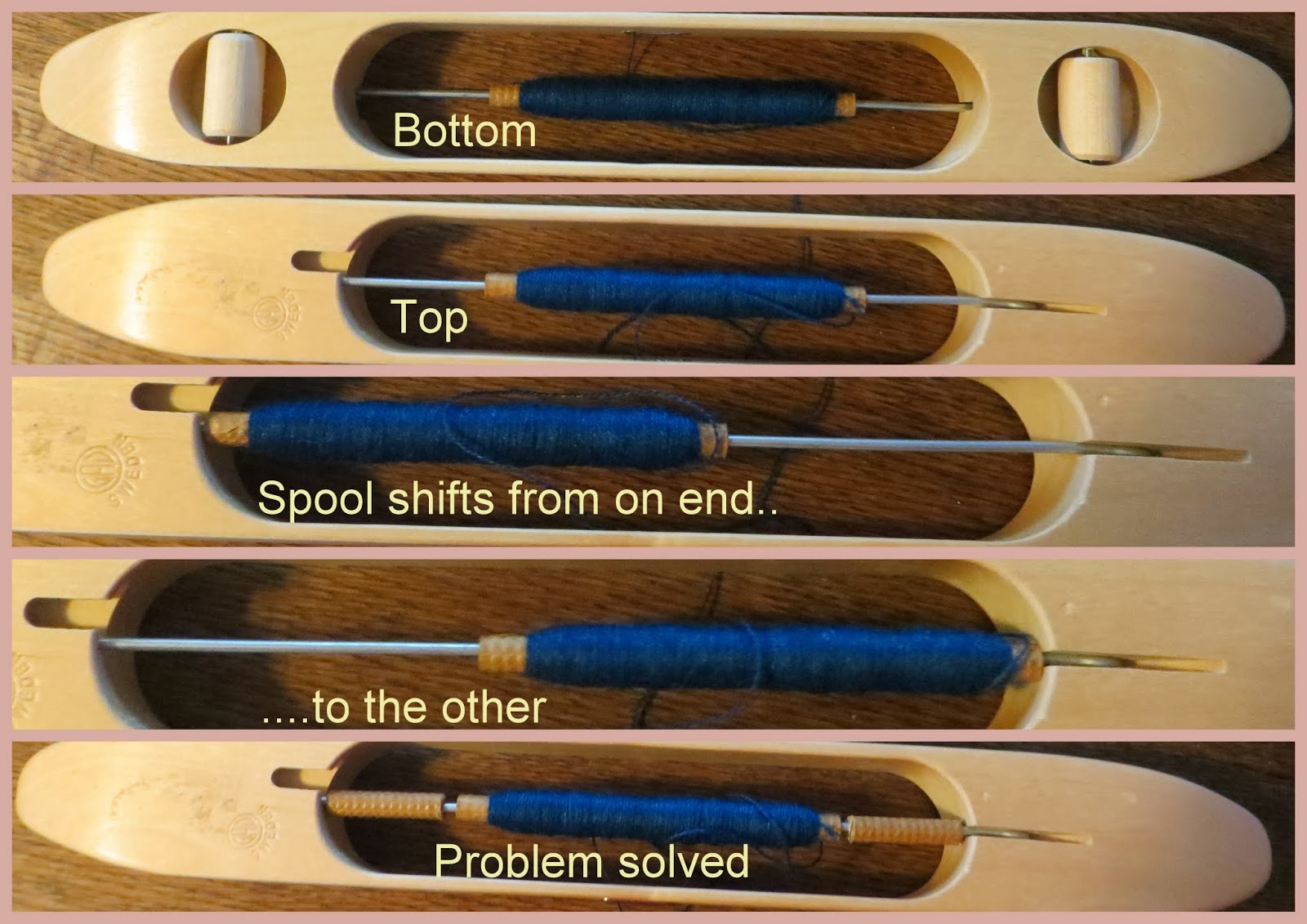
I determined that the reason was that I was using a new shuttle. Normally when drawing a boat shuttle out of the shed I move it forward (to create the weft angle), stop the spool from letting out any more yarn by putting my thumb on it so that I am pulling the selvedge on the opposite side in just a little bit before I close the shed, release the tension on the weft and beat.

I have bought a new Glimakra shuttle, one with wheels. I wanted a shuttle that was light and well spread out so that it didn't go crashing through the floor of the shed. At only 6 ends per inch of 20/2 yarn the shed floor is not that robust. The shuttle trundles through the shed very nicely but because it is quite long the spool can shift from end to end which meant that I was missing the spool with my thumb and therefore not applying any tension to the selvedge. I have resolved the problem by cutting bits of another spool and using them as wide washers. Picture #4 above shows a marked improvement on the last dozen picks (though the beat looks to be a bit variable!

 I shall weave another 9" of sample before I start to weave the scarf proper - that should be enough to get everything bedded in.

PS. It has just occurred to me that what I am calling spools should in fact be called quills - I shall have to check.