Pages

Thursday, April 29, 2010

Texsolv Heddles are easy to put on!

I was not looking forward to putting extra texsolv heddles on my Ashford loom as the last time I put some on a loom it was on 24 shafts and it took a very long time.

As one tends do do nowadays when pondering on a problem, I did a google and came to this site, http://www.earthguild.com/products/weaving/texhed/rtexhed.htm, and it all become clear. You do not take off the ties on the bundles of heddles until after you have put them on the harness, so they all go on at once in three simple steps! I have been cutting the ties and putting them on one by one! Oh wa ta na Siam!


Tuesday, April 27, 2010

Flying shuttle on Nilart and not enough heddles on Ashford

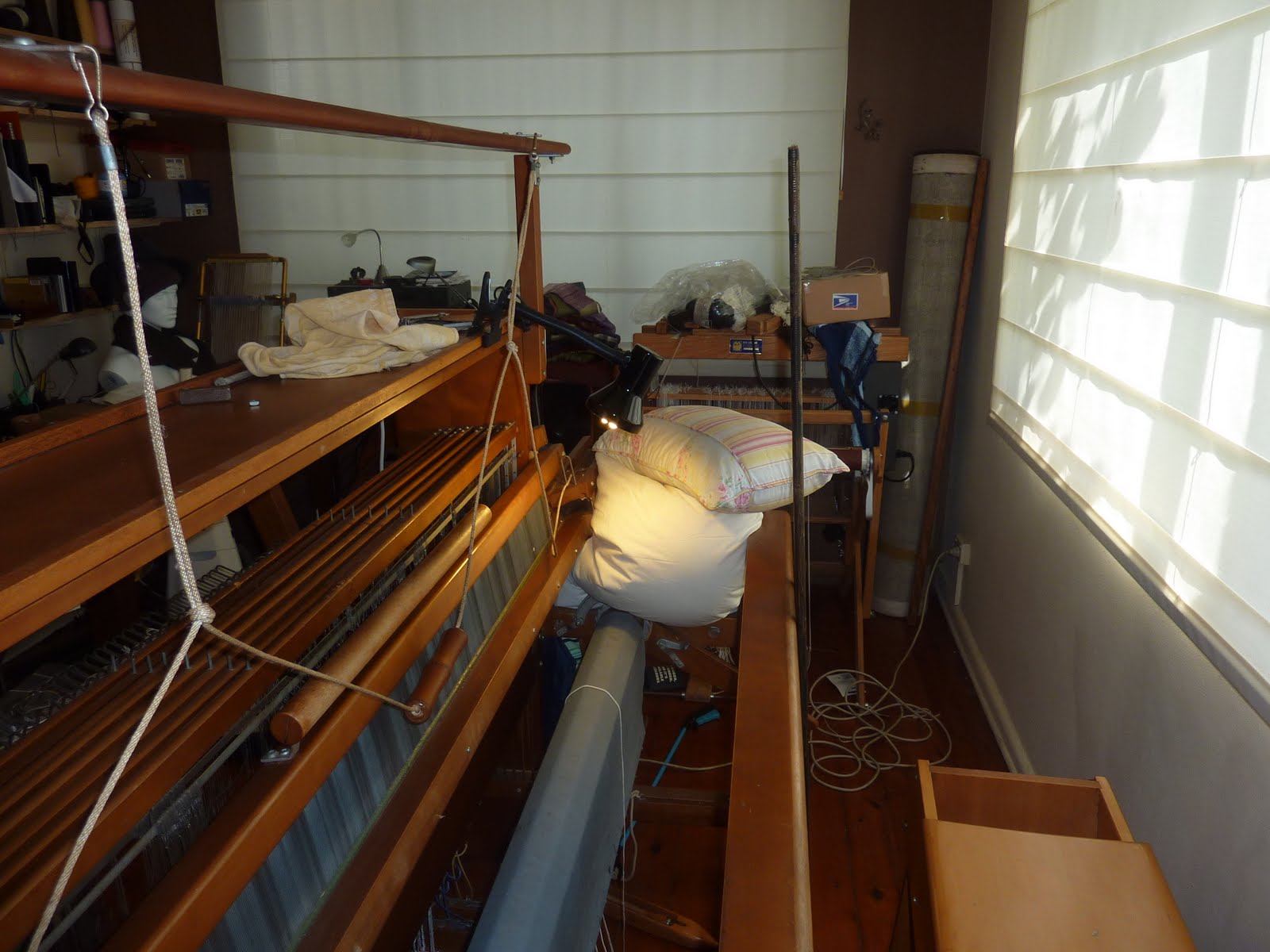
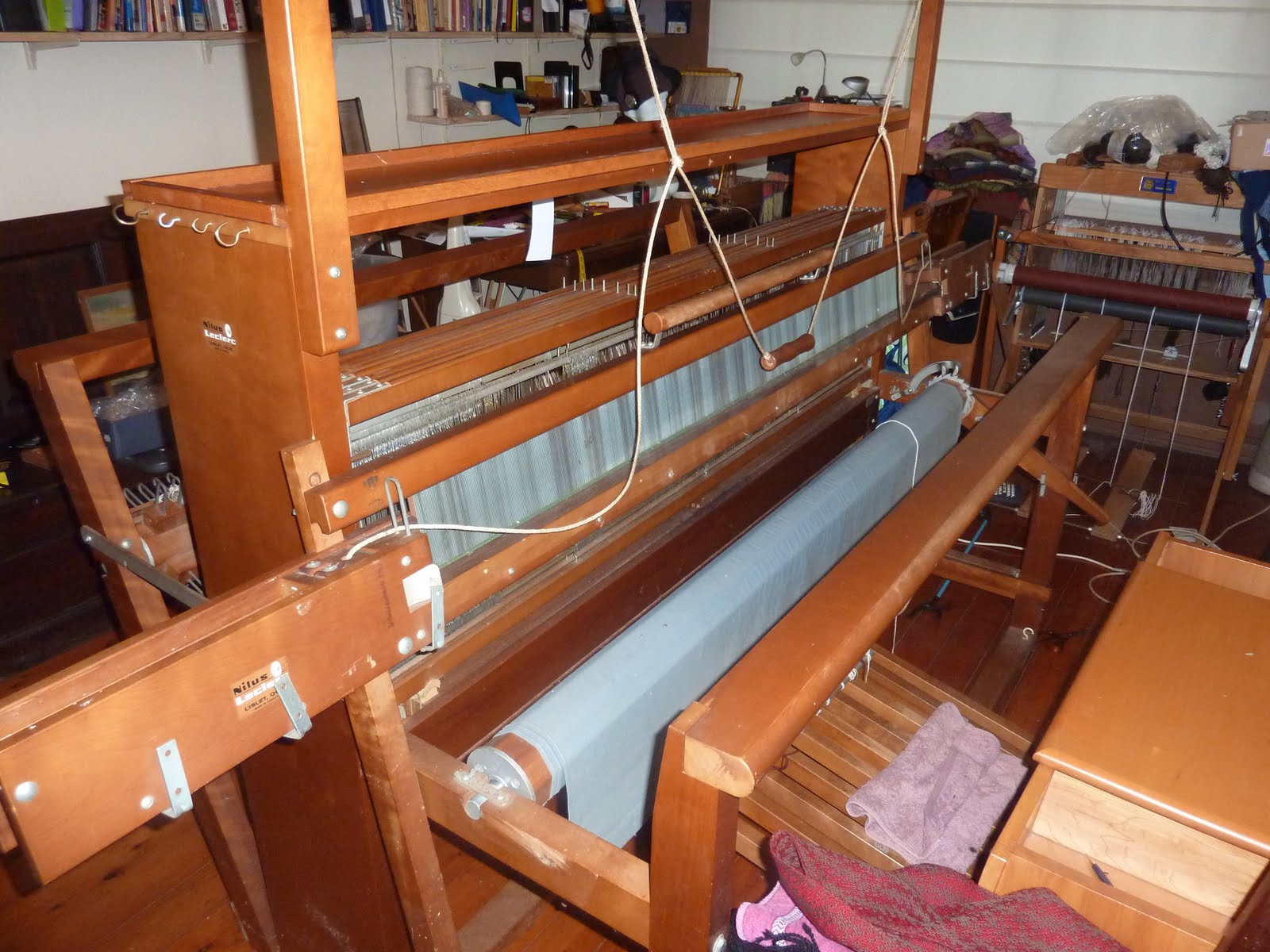
Whilst cleaning my Nilart I decided to fit the flying shuttle beater. The fitting was no problem, but oh my gosh, do those shuttles go! The second picture shows the barricades of pillows that I had to put in place to catch the damn thing before it wreaked total havoc. Once I realised that the problem was that the cord was too loose and was deflecting the shuttle order was restored.

I was very tempted to put on a warp straight away so I could start using it but I was very good and stuck to my plans to work on the stitched double weave sampler.

 Before I do anything else I have to put on some more heddles; not my favourite task. I do feel that the manufacturers could have supplied just a few more to start off with. The draft that I am using has one layer threaded on shafts 7 and 8 whilst the other layer is spread between shafts 1 to 6, hence the discrepancy in heddle numbers. The same problem would have arisen if I had decided to do some Huck.
Posted by Picasa

Sunday, April 18, 2010

No warp on the loom

Now that the poppy waffle scarf is off I have come to the end of the 15 yard warp that I put on to my Nilart loom last August. I am at a bit of a loss as it had almost become a permanent fixture. Putting on the warp was interesting as it was the first time that I had done such a long warp. It nearly got away from me a couple of times  but it all came good in the end.


 I wove two Brighton Honeycomb scarves before we went on holiday in mid October, a twill scarf in November and then the loom sat idle for two months whilst I moved on to some other projects.This year I have woven a twill scarf using an alpaca yarn for the weft and last of all came the waffle weave scarf.


I shall give the loom a good clean and polish and check all the screws and bolts, then it can have a rest whilst I get back to a stitched double weave sampler that I have half beamed onto a table loom.

Twill Scarf

 In addition to the work that I have been doing this weekend on poppy waffle (see previous post)  I have also finished off a scarf that had been on the loom before I started with waffle. This was on the same warp (straight 8) but using brown alpaca as the weft. I bought this yarn 9 months ago from John Arbon Textiles( http://www.jarbon.com/ when I was across in the UK for my son's wedding, so it was about time that I used some. Mind you, I haven't touched the yarn I bought the year before that when I went over for my other son's wedding.

 The pattern is the first one in "A Weavers Book Of 8 Shaft Patterns" (ed. Carol Strickland) and it was a nice "comfort weaving" exercise. I have used the draft before on another twill scarf but this one went much better.


Poppy Waffle Scarf is finished

I took the scarf off the loom on Thursday and I have had a pleasant time twizzling, repairing and finishing. Twizzling takes time so if I embark on a shawl I shall have to invest in an electric hair braider. I took the opportunity to combine this with a physical and digital reorganisation of my CDs.

Here are some before and after photos to record how much" waffling" I achieved. It certainly changes!  The photo on the right is a more accurate representation of the colour; the weft is Bendigo 2 ply "Holly". This draft obviously does not produce super deep cells (see here for the real thing http://fibresofbeing.wordpress.com/2010/04/08/waffle/). I shall probably return to this structure when the pressure for new tea towels becomes too much to resist.                                                                                                                      
I

Sunday, April 11, 2010

Finding the time

In spite of my best efforts the Poppy Waffle scarf still has another 20"more to go. I have been grabbing little bits, and some big bits, of time to weave but other priorities have to take precedence sometimes. The lawn was getting to a silly height!

The frog is called Freddy.

Thursday, April 1, 2010

Poppy Waffle


I started weaving this today today. In future I am always going to do a sample when changing the weave structure. On this scarf I started as soon as I could after lacing on and I had a succession of gremlins (broken selvedge, incorrect warp tension, shuttle too tight, weight falling off the warp beam) within the first nine inches. Once all these things were fixed and I was into the rhythm of the weave everything was fine.

I won't be doing much weaving over the Easter weekend as we are off down south to a rello bash but I might be able to get a bit more done on Monday and I should have it off the loom by next weekend. Then I have to decide what to put on this loom next; at the moment it is a toss up between huck lace or deflected double weave.

Sunday, March 28, 2010

Waffle Weave

Gosh, I didn't realise that I had not done an update for such a long time! More resolve!

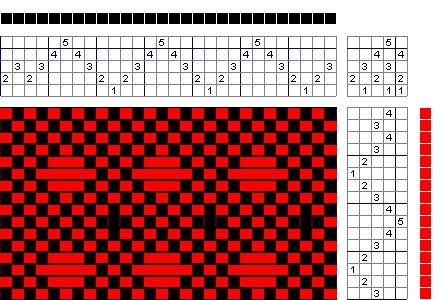
A couple of weeks ago we studied waffle weave at our weaving class (http://nsweave.org.au/learn/class.html). I have enough warp on my loom, threaded straight 8 at a twill sett, for one more scarf so I am going to try waffle weave. The waffle weave four shaft pointed drafts included in our class notes translate nicely into straight 8 threading and I selected the one below  because shafts 2 and 3 weave plain weave which means that I don’t need a floating selvedge.
On the left is the original draft and on the right is the 8 shaft derivation


Setting up the loom was easy – all I had to do was rethread the last two threads on each side into shafts 8 and 9, reweight the selvedges and then get under the loom to change the tie up. There are 5 treadles, odd numbers on my left foot, even ones on the right. Whilst I was under the loom I put in more texsolve cords with arrowherad clips to replace the knotted nylon tie up cords that came with the loom.

I am using a red weft so I have named the colour scheme Poppy.

The frustrating thing is that I got all of this preparatoty work done by yesterday afternoon ready for some serious weaving on Saturday night and Sunday morning but I have had to be at work because of some major problems that need to be attended to. I hate computers!


.


Saturday, May 16, 2009

Tree Trunks Twill

Concept
In May 2008 my wife and I visited the National Gallery of Australia to see the exhibition Turner to Monet. It was absolutely brilliant and I wished we could have stayed longer. I was very taken with "Tree trunks in the grass" by Van Gogh and I saw lots
of complex twills within the painting. When we got home I assembled some of my cones of wool that were as close as I could get to the colours of the painting and came up with a design for a striped twill scarf.

Details
Straight Twill, 3/1 tie up, straight lift
LeClerc Initiation 4S
Warp & Weft, Bendigo 2 ply (2927 yds/lb)
Warp colours, Mulga, Pampas, Guava, Sequoia, Moss
Weft colour, Seaquest
Sett 18epi
Width 12", 216 ends
Warp length 240""
PPI 16
Final width 11.5"
Final length (excl. fringes) 70"

Results
Well, I am going to have to try again to get a match with Vincent's colours but no matter as his picture sparked an idea. I wove the second scarf with a herringbone lift but to my shame I have yet to twist the fringe and wash it. It is currently masquerading as a wall hanging in the dining room.

There were quite a few first in the weaving of these scarves;
  1. Taking the reed out of the beater and supporting it horizontally for sleying.
  2. Using an end feed shuttle
  3. Using a roll of paper to measure woven length
  4. Cutting off the first item and then re attaching the warp for the second item
  5. A home made friction brake


Herringbone Twill Scarf

Concept
This was my first twill scarf which I wove in November 2007. We had woven a twill sampler in class earlier in the year and I wanted to put what we had learnt into practise. Another driver was that I had just bought a load of 2 ply wool so there were lots of interesting colours to think about as well.

I put on a long warp, wove a multi coloured sampler and then wove this scarf. The idea of the broad stripes at the ends came from a Paul Smith scarf I had seen.

Details
Herringbone Twill (Marguerite P. Davison, Page 26, Threading No. 8,
Warp & Weft, Bendigo 2 ply (2927 yds/lb)
Warp colour,, Pampas
Weft colours, Pampas, Guava & Celery
Sett 18epi
Width 10", 180 ends
Warp length 182""
PPI 16
Final width 8.5"
Final length (excl. fringes) 55"

Results
I made a miscalculation on the warp length and ended up with only 55" of scarf ; I now use an adding machine paper roll attached to the cloth beam to determine how much is left to weave. I consider this as my "overcoat" scarf, to be tucked in neatly under the collar.

Considering the range of colours I had to choose from I think that I was a little timid in my selection. However, I enjoyed weaving it, made some good learning mistakes and have a scarf for occasional wear.

Thursday, May 14, 2009

Erica Scarf

Concept
I wove this scarf in October 2007. I had just bought my first floor loom (LeClerc Initiation) on eBay and I was anxious to give it a whirl. This was also the first time that I had used a boat shuttle and the first time that I had worked on something that was not a part of our weaving lessons. I was trying for a "heathery" sort of colour scheme


Details
Plain Weave
Warp & Weft, Bendigo 2 ply (2927 yds/lb)
Warp colours, Venetian, Seqoia & Plum
Weft colour, Light Plum
Sett 14epi
Width 12", 168 ends
Warp length 98"
PPI 12.5
Final width 10.5"
Final length (excl. fringes) 62"


Results
There were several false starts and two unweavings before I managed to get the selvedges under control. The piece does not do too well if held up to the light for a close inspection of the evenness of the beat, but that is not too noticeable when I am wearing it.